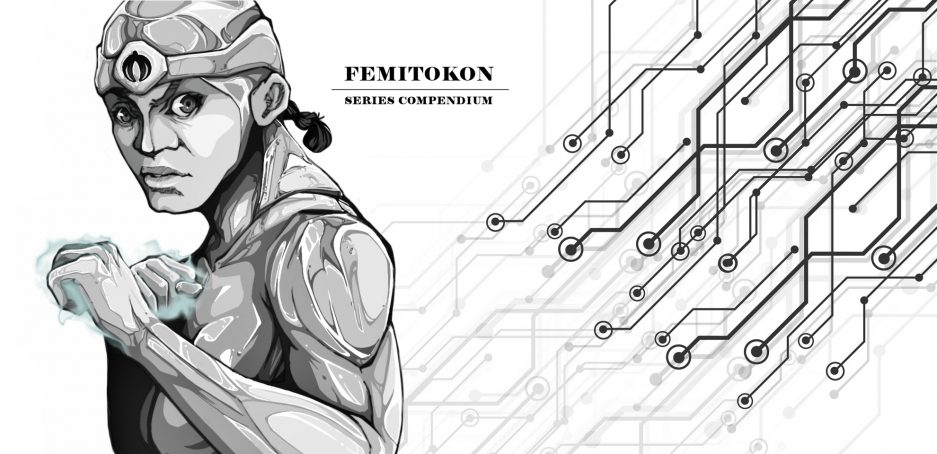
Femarctic eusociality comes from a genome structure that divides them into functional behavioral groups, called castes. Scheduled generational cycles set approximate delivery goals for each caste, but the actual number per caste was beyond their control until the production of the Eleventh Ramaxian Generation.

ANATOMICAL BASICS
- Mitochondrial transplantation is how the femmar produce offspring.
- Femmar develop their caste designation in utero; there are 4 castes.
- The average height range of a typical adult is 6’5” to 7’5.
- Femmar have 280 bones and 52 chromosomes.
- Their renal system can process salt water and allow for saline digestion; too much salt can be fatal.
- The femmar have an epigonal organ.
- Femarctic craniums are thicker than those of helovx, and their brains are larger, with greater synaptic inter-connectivity.
- Femmar have 38 teeth.
- Frontal teeth are lobed and cusped; back teeth are thick and flat.
- All Femmar have off-white sclera, and gold/bronze irises.
- The eyes contain a protein in the vitreous that breaks down abrasives and protects against lachrymators.
- The eyes also have a layer of tissue called hizrut (tapetum lucidum), which allows them to see in the dark.
- Femmar have no axillary or androgenic hair.
- All terminal and vellus hair is black.
- Subaki and Zaxiri only have terminal hair on their heads.
- Bizaki have sparse vellum on their extremities and terminal on their heads.
- Hizaki have light vellum on their extremities, lower back, and forearms, and terminal hair on their heads.
- Marixi have no vellum or terminal hair.
- Femmar have eight layers of counter-shaded skin (dark throughout, but light over the chest, abdomen, and pelvic girdle).
- Femarctic hides come in various colors, from bronze and brown to shades of gray and blue, with patterns ranging from light stripes to mottled spots; many femmar have no patterns at all.

- Femmar have globes of subcutaneous fat over the chest called suzsch (soosh). Running vertically over the middle of each suzsch is a sensitive seam called an uzx (ooziks).
- Marixi have differing suzsch and uzxi.
- Femarctic genitalia come in varying shades of blue.
- Femmar have a guzshlix (goosh-liks) (vagina), and a gurxul (gerks-ill), a genito-anal slit used to expel urine and feces. The folds of the guzshlix, called the gashcol (gash-kol), contain a rydok (rid-ock) (clitoris).
- The opening of the guzshlix centers on the pubis; the elongated folds of the gashcol run vertically between the hips. Two inches below the lower end of the gashcol is the gurxul.
- Femmar have a guzshlix (goosh-liks) (vagina), and a gurxul (gerks-ill), a genito-anal slit used to expel urine and feces. The folds of the guzshlix, called the gashcol (gash-kol), contain a rydok (rid-ock) (clitoris).
- All Femmar, except Marixi, have a makodux (mack-oh-doks) and a makzol (mack-zal).
- Bizaki and Hizaki makoduxi never mature to a size similar to those of Subaki or Zaxiri.
- Femmar produce a hormone called mitokerotein, a natural steroid not found in any other species on Ramaxicon.
- MitoK developed independently within the last generation of subjects engineered by the Femaki’xirpaxul.
- Helovxi call MitoK’ Femarctic Testosterone’, but studies confirm no similarity to helovx testosterone.
The Femmar can remain submerged for extended periods.
Femarctic speed and dexterity in the water is by design; they have a low volume of bone marrow, so their dense bones make them more buoyant. Femarctic ribs are bound by loose, bendable cartilage, allowing the rib cage to collapse in minor degrees, under high pressure that would snap helovx bones. Femarctic lungs are pliable, enabling them to live in extreme depths.
Elevated levels of oxygen-carrying proteins (neuroglobin and cytoglobin) in their brain allow them to thrive in low-oxygen conditions. The high concentration of oxygen-carrying cells in their muscles, combined with the fact that femmar possess two to three times more blood than helovx, makes it possible for femmar to remain underwater for periods of 60-75 minutes on average; the ability to reduce their heart rate allows them to conserve oxygen.
Femmar have an inherent immunity to most diseases, including cancer.
Femmar have a highly developed epigonal organ; like the ocean-dwelling Chondrichthyes (sharks), they possess only one class of broad-spectrum serum antibody similar to those found in helovx infants. In helovx, this broad-spectrum antibody class is replaced by specific antibodies as a helovx child is exposed to a greater variety of pathogens as they mature; conversely, the femmar, like the shark, retain their non-specific immune response throughout their lives.
This generalized immune system is why Femmar can detoxify potentially harmful compounds quickly without prior exposure.
- Willing Bizaki and Marixi allowed Jungwanian scientists in Yazhou to inject them with carcinogens, coliform bacteria, and exotic fungal toxins, at concentrations that would kill helovx. Researchers found that femmar detoxified these pathogens quickly, without any ill effects. Unfortunately, these serum antibodies ceased to function outside their physiology, thus disabling helovx from harvesting antibodies for vaccines.
- Femmar | Femarctic Castes
- Bizaki | Hizaki | Marixi | Subaki & Zaxiri
 FEMITOKON
You must be logged in to post a comment.