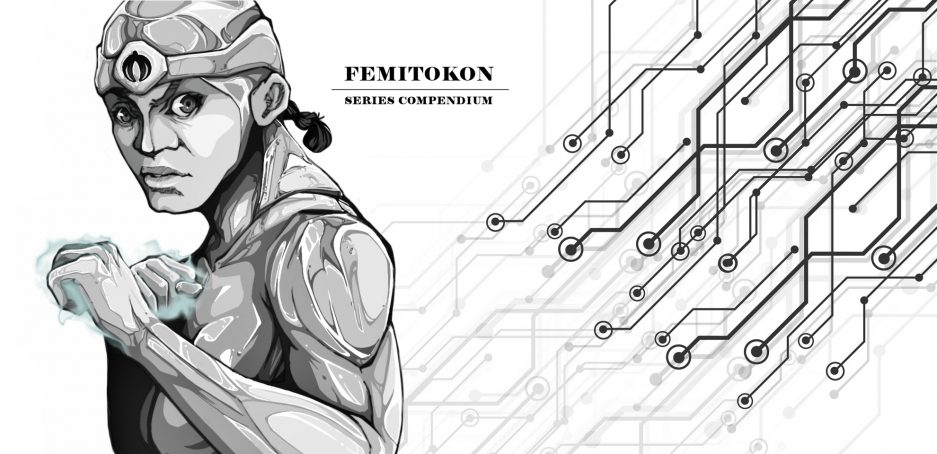
Though born with a viable gen code, the social stratification of a Femarctic Male left him powerless and dependent on his female pod members.
Sixth-Gen males, dependent on the Citizenry for even the basest of necessities, found themselves in a deeply marginalized state exacerbated when the Citizenry Vocational Annex deemed males ill-suited to mingle with other donational-age femmar. Barred from caste training, these males lived in social isolation, becoming objects of curiosity. As the Sixth matured sexually, males faced unhealthy scrutiny from them and their elders in the Fifth.
Charges leveled at older citizens caught sexually interacting with males between ages 12 and 14 could not prosecuted because males were not citizens in the eyes of Ramaxian Law.
When the Sixth came of age, unaccompanied males encountered violence at bizaraks and sporting events at the Fairgrounds, legislators denied males access to citbluz, restaurants, garden clubs, or hizix bars; they also denied them the right to inherit or own property. When health centers began documenting pregnancies among the older zaxiri of the Fifth, laws came about limiting the Citizenry’s access to males no longer living at home; no male could be outside the house without being covered from head to toe in attire designed to hide their physical characteristics. If found alone and out of sight, the Citizen’s Guard collected them until a pod member or custodian could reacquire them.
Despite the challenging conditions, the Sixth-Gen males managed to enjoy more freedom than any male born after them.
Fifth Gen pregnancies among citizens, not Zaxir, all ended in the death of the citizen; this did not stop the floodgate of Sixth Gen citizens seeking out males their age for the sexual experience. The free-birth era officially began when Zaxiri of the Sixth initiated a movement of enticing males from the prisons of their Fifth Gen makers’ homes to live with them in the bluzsh. Once these males bean prostituting themselves, unscheduled pregnancies rose drastically.
Many liberated males left sex work to care for the growing number of freeborn donations that needed minding as the Citizenry assigned no gen codes to a freeborn. In 2154, the Generational Production Department, in partnership with Donational Services, quietly began the first male collections of male citizens and freeborn donations for covert termination. Bizaki, Hizaki, and Subaki dying in birth increased, forcing the Generational Production Department to legally require a GPD-assigned physician at all freeborn deliveries overseen by the Zaxiri College. When it became apparent that the task of the physician was to euthanize all donations born male, the Zaxiri College barred these assigned physicians from the birthing rooms.
These same Sixth-Gen members of the Zaxiri College transitioned the deceased gen-codes to their newborns; these donations were registered manually as “Seventh Generation” citizens.
Fifth Gen Sernatae Bulata Kul presided over the custodial dispute between the College and the GPD. Caught in the power struggle between the incoming Sixth Ruling Platform and the Fifth Gen dominated Chamber, Kul reminded the Zaxiri College that the GPD held jurisdiction over all forms of production, including freeborn. Sixth-Gen administrators of the Zaxiri College entered the Cloister during its Third Session. They demanded severance from the GPD, finding its policies against newborn males to be overreach similar to those applied by the original subject, Uymras, when she forced Subaki to give birth against their will. After a contentious session, the Fifth Gen Chamber told the incoming Ruling Platform of the Sixth that if they wanted Fifth Gen acceptance of their ascension, they needed to produce a legitimate scheduled production via the GPD. In return, the Zaxiri College could outside the confines of the GPD.
Male Collections and the Cessation of Design
The actions of the Sixth Ruling Gen, following the evolution of Femtrux, led to the retraction of all manually assigned gen codes, setting off a period of political turmoil known as the Patch Wars. Compliance with Femtrux to restore generational balance resulted in the termination of an Eighth Gen and the forced production of a Ninth.
Sixth Gen officials, now in control of the Prime Lab, opened the first Male Haven shelters, where males of the Sixth and freeborn Seventh turned themselves in willingly for what they believed would be a better life. Here, males lived in amiable conditions while physicians and counselors studied their behavior and physiology. After noting the absence of any Ninth-Gen males surrendered to the Havens, legislators ordered a ‘second-collection‘ in 2179, accompanied by a campaign warning of the dangers of birthing and citing males as the sole cause of birthing deaths.
In the years that followed, an atmosphere of distrust developed throughout the domes as citizens were encouraged to look out for pods ‘housing their males’ (keeping males indoors since birth) and to report these citizens to their local Guardia. The advent of the Caste-Developmental Disorder diagnosis gave rise to the Retraining Movement.
Despite scheduled born males being coded to exist only as Subaki and Zaxiri, nearly all freeborn males developed beyond these designations. Doctors transitioned males with Bizaki or Hizaki inclinations (there has never been a Marix-born male) to a behavior modification program called the Retraining and Education Program (RETRED). Males in RETRED endured clinical conditions until the Ninth Gen entered positions of power within the program. RETRED program engaged in unethical methods that included chemical castration, forced surgical alteration, and abusive mental and physical conditioning. In the mid-2190s, males who failed to retrain were transferred to Orta Main and incarcerated within Marixi habitats alongside low-ranking Fleet personnel. These surrendered males, called ‘Caste-Offs,’ faced a brutal life where abuse and assault were common. Cast-offs took on passive roles to Fleeters in exchange for safety within the barracks. This unpleasant life led to high rates of suicide.
When Fusa Kul and her Ninth-Gen Committee took control of Ramaxia in 2197, its Fifth Office, Doctor Wox (Banto) Dag, nationalized the GPD, thereby removing its autonomy in producing scheduled generations. After losing her bond partner during the delivery of a freeborn donation, Primary Kul proposed outlawing Freeborns, setting the stage for CM5 Dag to enact a cessation of male design.
In 2203, Kul’s administration passed the Balanced Citizenry Act. Authored by CM5 Dag, it outlawed male existence in the Citizenry.
Male Collections by the ruling Ninth were by far the most substantial and sinister. Agents of the newly formed Terminal Sabotage Division collected ‘housed’ males for termination and recycling in Orta.
After the population deficit brought on by the two-year Sister-Suicides in 2224, where a significant number of citizens took their own lives, Femtrux took hive Faltrix offline, halting death processing throughout the domes. Femtrux had the power to interfere in mandated procedures only when an imbalance threatened the Citizenry; the lifeform decreed that maleness was not a valid cause for male termination. Faltrix processed no dead male brought to her, nor would she process a living male without speaking to him first to assess if he intended to self-terminate. Unwilling to halt her collection and termination of males, CM5 Dag ordered the formation of the Femitokon Division to weed out Ninth- and Tenth-Gen males ‘hiding in the hide’ (disguising themselves as females to live among the populace.)
The Caste-Off program in Orta ended in 2239, the same year Generation #10’s Secondary Heir died during that generation’s Secondary Final Trial. After her recycle, the Femitokon Division entered lower-Fleet habitat’s, rounded up and then terminated all sixty-three males living there.
No males exist in Generation #11, produced between 2228 and 2229. There are also no freeborn donations. Still, in 2232, then Utama Representative Laxum Jyr revealed the existence of Terminal Sabotage and the Femitokon Division to the Citizenry.
Jyr brought evidence before Cloister of their existence in the Sorority of Defense and accused CM5 Dag of arbitrarily murdering males outside the scope of Femtrux. She cited the creation of this Femitokon Division as proof that CM5 Dag was ethically unfit to serve on the Ruling Platform. Ultimately, the Sernatae chose to regulate Terminal Sabotage and allowed the continued existence of the Femitokon Division because all witnesses from this newly formed unit testified that no males existed. Thus, no male had yet been terminated outside the auspices of Faltrix.
Although officials claim that no more males live in Ramaxia, hive Faltrix’s records of Seventh, Ninth, and Tenth-Gen citizens dead from giving birth do not match the numbers of dead freeborn citizens, nor do they match the number of males collected by the Femitokon Division. Figures estimate that there are at least 260 unaccounted-for males.
- Femarctic Males in Ramaxian Society
 FEMITOKON